Savoir-vivre & rueBruit et appels en public
Phone calls and noise on Japanese trains
La réponse courte
Don't talk on the phone on trains or buses: put it on silent mode (manner mode) and step off or wait to call back. Keep conversations quiet on public transport, and turn down music in headphones that leak sound.
No calls on trains and buses
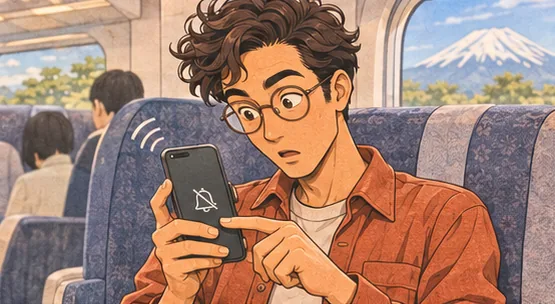
Talking on the phone on public transport is one of the few things that gets visible disapproval in Japan. Announcements ask passengers to set phones to マナーモード (manā mōdo, silent or vibrate) and not to make calls.
If someone calls, answer in a whisper to say you'll call back, or wait until the next station and step off.
Talking
Quiet conversation is fine. Loud groups stand out, especially on commuter trains in the morning. On long-distance trains and shinkansen, people talk a little more freely, but calls still go to the space between cars.
Headphones and video
Use headphones, and check they don't leak sound. Watching videos with sound on the speaker is a no.
Priority seats
Near some doors, 優先席 (yūsenseki) are priority seats for older people, pregnant women and people with disabilities or small children. Signs on some lines ask people to switch phones off near priority seats.
Elsewhere
In restaurants, cafés and shops, step outside for calls. In temples, shrines and gardens, keep voices low.
Montrez ceci au personnel
すみません、今電車なので、あとでかけ直します。
Sumimasen, ima densha na node, ato de kakenaoshimasu.
Sorry, I'm on the train. I'll call you back.
Ce que la plupart des voyageurs règlent avant d’atterrir
- Lien affiliéVoir les options
eSIM Japon (Airalo)
Des données mobiles dès l’atterrissage.
- Lien affiliéVoir les options
Billets de train au Japon (Klook)
Trains d’aéroport et shinkansen, réservés en anglais.
« Publicité » = un annonceur a payé pour cet emplacement. « Lien affilié » = nous pouvons toucher une commission. Ni l’un ni l’autre ne change nos recommandations.