
Etiketas ir gatvėsEilės ir eskalatoriai
Queues and escalators in Japan: which side to stand on
Trumpas atsakymas
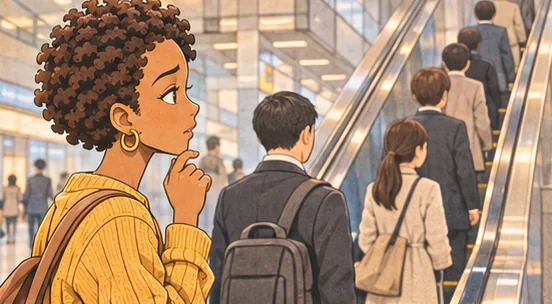
People queue in neat lines marked on the platform floor and board after passengers get off. On escalators, people traditionally stand on the left in Tokyo and on the right in Osaka, though railways now ask everyone to stand still on both sides and not walk.
Escalators
- Tokyo and most of eastern Japan: people stand on the left, leaving the right side clear.
- Osaka and much of Kansai: people stand on the right.
- Railways and several prefectures now ask everyone to stand still on both sides and not walk, for safety. Saitama and Nagoya have made it a rule. In practice, follow what the people in front of you do.
With a big suitcase, hold it on the step in front of you, or use the lift.
Platform queues
- Markings on the platform floor show where the doors will open and where to line up, sometimes in two or three lines.
- Let passengers off first, then board in order.
- On crowded trains, stand back from the door if you're not getting off soon, or step out onto the platform to let people off, then get back on.
Shops and restaurants
- Popular places have queues outside. Join the end (最後尾, saikōbi). Staff often hold a sign marking it.
- Some places take your name on a list instead: look for a clipboard or ticket machine at the door.
- Don't save places for friends who aren't there yet.
Parodykite tai darbuotojams
ここが列の最後ですか?
Koko ga retsu no saigo desu ka?
Is this the end of the line?
Tai dauguma keliautojų susitvarko prieš nusileisdami
- Partnerio nuorodaŽiūrėti pasiūlymus
eSIM Japonijai (Airalo)
Mobilieji duomenys nuo nusileidimo akimirkos.
- Partnerio nuorodaŽiūrėti pasiūlymus
Traukinių bilietai Japonijoje (Klook)
Oro uosto traukiniai ir šinkansenas, užsakomi angliškai.
„Reklama“ = reklamuotojas sumokėjo už šią vietą. „Partnerio nuoroda“ = galime gauti komisinį mokestį. Nė viena jų nekeičia to, ką rekomenduojame.