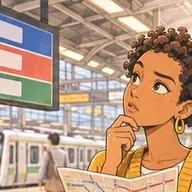
Same platform, different stops
On busy lines, several kinds of train use the same tracks and platforms. They don't all stop at the same stations. The type is shown on the platform screen and on the front and side of the train, usually in a different colour for each type.
- 普通 (futsū) or 各駅停車 (kakueki teisha): Local. Stops at every station.
- 準急 (junkyū): Semi-express. Skips a few stations.
- 快速 (kaisoku): Rapid. Skips some stations.
- 急行 (kyūkō): Express. Skips more.
- 特急 (tokkyū): Limited express. Stops only at major stations.
The names don't mean the same thing on every line. A rapid on one company's line can skip more stations than an express on another. Don't go by the name: check the stops.
Check before you board
- The platform screen shows the next trains with their type and destination, switching between Japanese and English.
- The stop chart on the platform wall or pillars shows which types stop where. A dot or line at your station means that type stops there.
- Route apps like Google Maps name the train type for each step. Match it to the screen.
- On the screen and in announcements, 通過 (tsūka) means "passing through": that train won't stop here.
If you're unsure, take the local. It's slower but stops everywhere.
Fares
Local, rapid and express trains usually cost the same as each other. On JR, a limited express always needs an extra limited express ticket. On private railways it depends on the company: some limited expresses are free to ride, others (like the Odakyu Romancecar) need a seat ticket.
Locals that wait for the express
On some lines, a local stops for a few minutes to let an express pass, often on the other side of the same platform. When the announcement says an express is coming, people step across to it to save time. Only follow them if the express stops at your station.
If you went past your station
- Get off at the next stop.
- Cross to the platform going back the other way. Don't leave the ticket gates.
- Take a local back to your station.
With an IC card like Suica, the fare is worked out from where you entered and where you leave, so you usually aren't charged for the detour while you stay inside the gates. On JR with a paper ticket, tell staff you went past by mistake: they can let you ride back to your station without paying again.
Next steps
- Lost in a giant station? See Lost in a huge Japanese station: transfers and exits.
- Train stopped and the screens are only in Japanese? See The train has stopped and the announcements are only in Japanese.
Bunu personele gösterin
この電車は_に止まりますか?
Kono densha wa __ ni tomarimasu ka?
Does this train stop at __?
_へはどの電車に乗ればいいですか?
__ e wa dono densha ni noreba ii desu ka?
Which train should I take to __?
乗り過ごしてしまいました。
Norisugoshite shimaimashita.
I went past my station by mistake.
Şu durumdaysanız…
- Yaşlı gezginler
- Local trains are usually less crowded than rapid and express trains, so a seat is easier to find. A few extra minutes can be worth it.
- Çocuklarla seyahat
- If you're not sure, take the local. It stops at every station, so you can't overshoot.
Riding trains in Japan?Book airport trains and the shinkansen in English [Reklamlar]
 Klook fiyatlarını gör
Japonya tren biletleri (Klook)
Havalimanı trenleri ve şinkansen, İngilizce rezervasyon.
Reklam: Bu bağlantılardan rezervasyon yaparsanız, size ek maliyet olmadan komisyon alırız. Bu, önerilerimizi veya sıralamayı asla değiştirmez.